
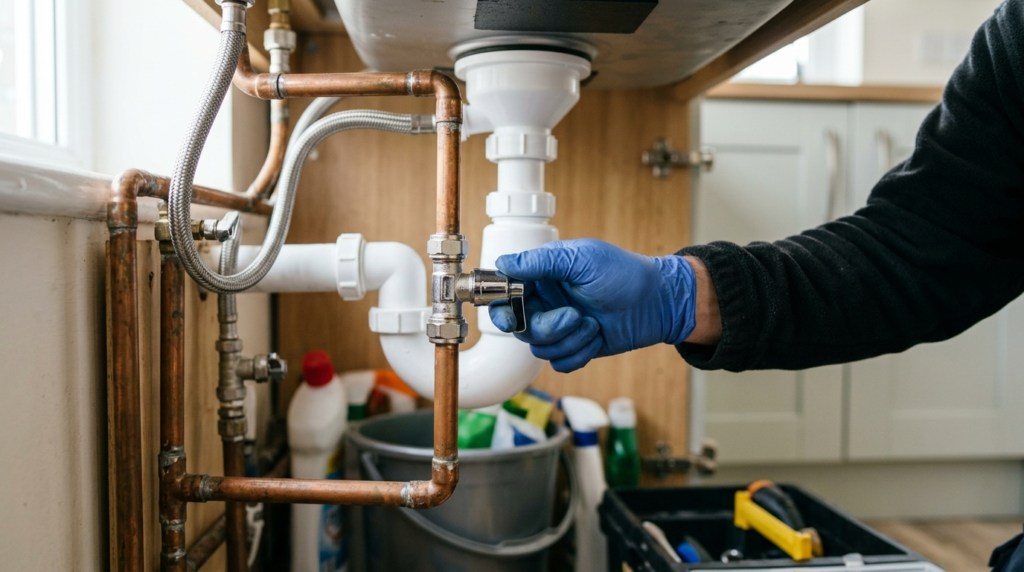
A plumbing isolation valve is one of those fittings nobody thinks about — until the day they desperately need one to work. Maybe a tap won’t stop dripping. Maybe the toilet is overflowing. Maybe a plumber has just asked you to “turn off the isolation valve under the sink” and you have no idea what that means or where to look.
You’re not alone. Isolation valves are tucked away in cupboards, under floors, and behind toilets across almost every property in the UK, and most homeowners only learn what they look like in the middle of an emergency.
This guide explains exactly what a plumbing isolation valve does, the different types you’ll find in a typical home, how to use one safely, and what to do when one leaks, seizes, or needs replacing. If you’d rather skip straight to getting one fitted or repaired, call Catalyst Home Services on +44 7400 265421 or book a plumber online and we’ll take it from here.
What Does an Isolation Valve Do?
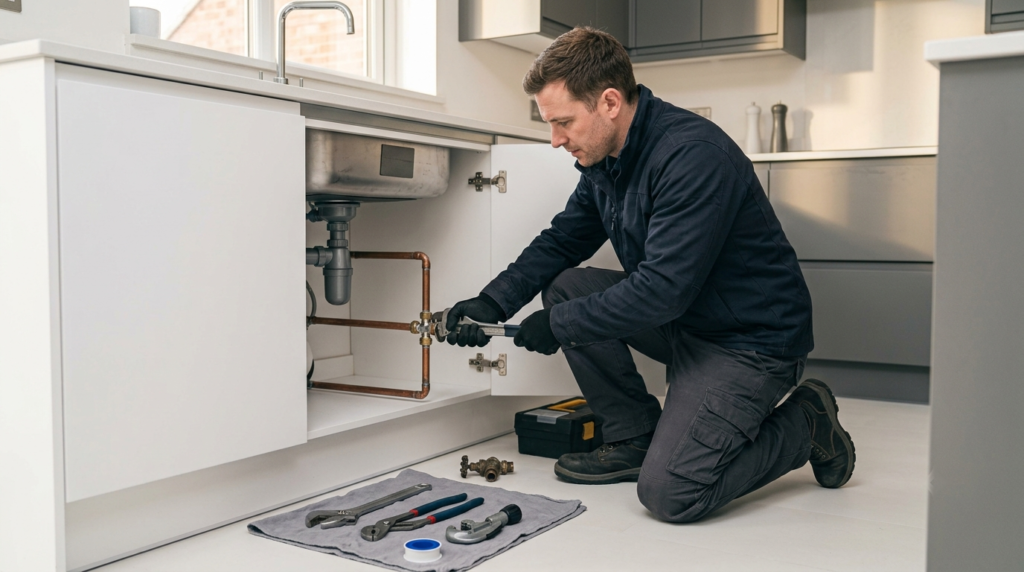
A plumbing isolation valve is a small shut-off valve that controls the water supply to a specific appliance or fitting without turning off the water for your entire home. It allows you to stop water flowing to individual fixtures such as taps, toilets, washing machines, dishwashers, and boilers while the rest of your plumbing system continues working normally.
You will usually find isolation valves under kitchen and bathroom sinks, behind toilets, near washing machines, beside boilers, and on outdoor tap pipework. They are designed to make plumbing repairs, maintenance, and replacements safer and easier by allowing a plumber or homeowner to isolate only the affected area.
If an isolation valve is stuck, leaking, difficult to turn, or fails to stop the water supply, it may need cleaning, servicing, or replacement. A faulty valve should not be forced, as this can damage the internal mechanism and create a larger leak problem.
For most modern UK homes, a quarter-turn isolation valve is the easiest type to operate. When the handle is aligned with the pipe, the valve is open. When the handle sits across the pipe, the water supply is closed.
Isolation Valve Not Working? Common Problems and Fixes
An isolation valve is designed to work quietly for years, but because most homeowners rarely use them, problems often remain unnoticed until there is an urgent plumbing issue. A valve that will not turn, continues allowing water through when closed, or starts leaking can prevent you from safely carrying out repairs and may need professional attention.
Here are the most common isolation valve problems found in UK homes and what they usually mean.
Isolation Valve Won’t Turn
A stuck isolation valve is one of the most common issues homeowners experience. Over time, mineral deposits, limescale, and corrosion can build up inside the valve mechanism, especially in areas with hard water.
This often happens because isolation valves are left untouched for years. When you finally need to shut off the water supply during a leak or repair, the valve may feel stiff or refuse to move completely.
Do not force a seized isolation valve with excessive pressure. Trying to force it can damage the internal components, break the handle, or cause the valve body to leak. A plumber can usually assess whether the valve can be serviced or whether replacement is the better option.
Isolation Valve Turns But Water Is Still Flowing
Sometimes an isolation valve appears to close correctly, but water continues flowing to the tap, toilet, or appliance. This usually means the internal mechanism is worn and the valve is no longer creating a complete seal.
This problem is particularly common with older slotted isolation valves and traditional gate valves. The outside handle may move normally, but the internal parts may no longer block the water supply effectively.
If the valve cannot fully isolate the fitting, it should be replaced before it is needed during an emergency.
Isolation Valve Leaking When Closed
A valve that leaks after being turned off may have a damaged internal seal, worn washer, or failing connection. Small drips around the valve body or spindle can become worse over time, especially when the valve is operated repeatedly.
A leaking isolation valve should not be ignored because it can cause water damage inside cupboards, behind toilets, or around appliances where leaks may go unnoticed for long periods.
Isolation Valve Handle Is Loose or Not Working
If the handle feels loose, spins without resistance, or no longer matches the valve position, the internal mechanism may have failed.
This can create a dangerous situation because the valve may appear closed while water is still flowing. During an emergency, this can delay stopping the leak and increase potential damage.
Isolation Valve Is Partially Closed
A partially closed isolation valve is a common cause of reduced water flow to individual fixtures. For example, a tap, toilet, or washing machine may have poor pressure while other parts of the home work normally.
This can happen after previous plumbing work when a valve has not been fully reopened. Check that the handle is completely aligned with the pipe for an open valve, or fully across the pipe for a closed valve.
When Should an Isolation Valve Be Replaced?
An isolation valve should usually be replaced when:
- It cannot fully stop the water supply
- It leaks from the body or spindle
- It is heavily corroded
- The handle or mechanism has broken
- It repeatedly becomes stuck
Replacing an old isolation valve with a modern quarter-turn valve can make future maintenance much easier and reduce the risk of emergency plumbing problems.
If your isolation valve is stuck, leaking, or not working correctly, Catalyst Home Services can inspect the valve, identify the cause, and recommend the safest repair or replacement solution.
What Is a Plumbing Isolation Valve?
A plumbing isolation valve is a small control fitted into a water pipe that lets you shut off the supply to a single appliance or fitting, without affecting the water supply to the rest of the property.
Think of your home’s plumbing as a tree. The main stopcock is the trunk — close it, and every tap, toilet, and appliance in the house loses water. An isolation valve is a branch — close it, and only the one fitting connected to it loses supply, while everything else keeps running as normal.
This distinction matters more than it might seem. Without isolation valves, fixing a single dripping tap would mean cutting off water to the entire household every time. With them, a plumber can isolate just the tap, toilet, or washing machine that needs attention and leave the rest of your home unaffected.
Isolation valves are sometimes called service valves, stop valves, or shut-off valves — different trades and manuals use slightly different terms, but they all refer to the same basic component.
Why Isolation Valves Matter
It’s easy to overlook a fitting this small, but isolation valves do a lot of quiet, important work in a plumbing system.
They make repairs faster and cleaner. A tap repair that would otherwise require shutting off the whole house can be done with a quarter-turn of the isolation valve beneath the sink. That’s the difference between a five-minute job and disrupting everyone in the property.
They limit damage during an emergency. If a supply pipe to a toilet or washing machine fails, the nearest isolation valve is often the fastest way to stop water pouring out before a burst pipe repair team arrives. Knowing where your valves are, before you need them, can save a genuinely significant amount of damage.
They protect appliances during installation and servicing. Dishwashers, washing machines, and water heaters all rely on a dedicated isolation valve so they can be disconnected safely for servicing or replacement — see our Water Heater Installation page for how this applies to hot water systems specifically.
They’re a legal requirement in modern installations. UK Water Regulations require isolation valves to be fitted at specific points in a plumbing system, including before certain appliances and outside taps. A property without them, or with valves that no longer work, isn’t fully compliant.
Types of Plumbing Isolation Valves
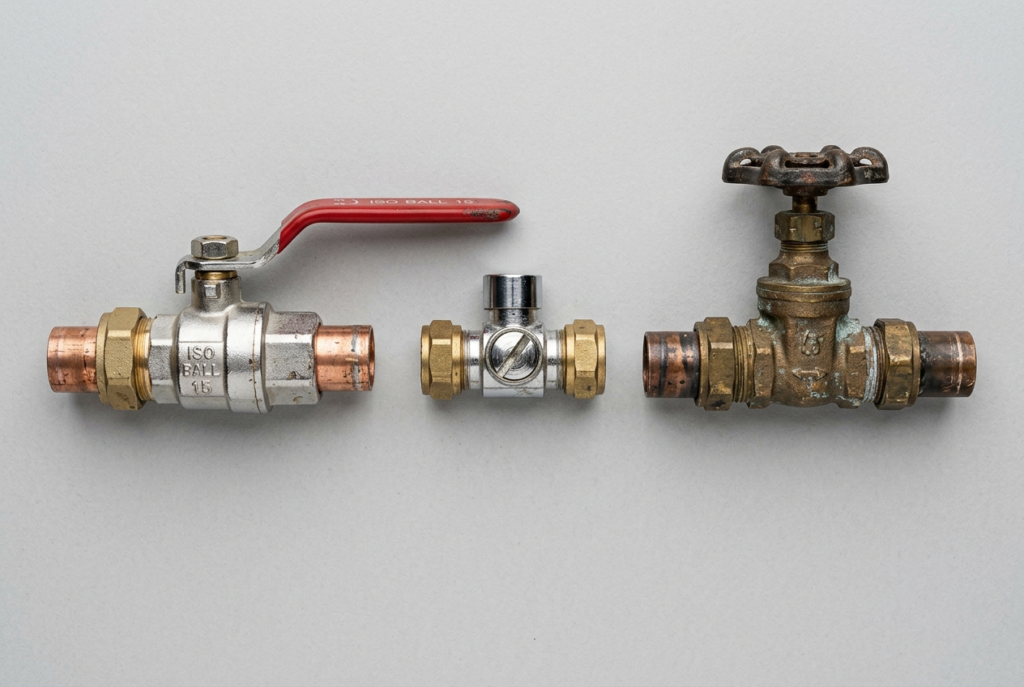
Not all isolation valves look or work the same way. Here are the types you’re most likely to come across in a UK home.
Quarter-Turn (Lever) Isolation Valves
The most common type in modern homes. A small lever or handle turns 90 degrees from open to closed — when the lever sits parallel to the pipe, the valve is open; turned perpendicular, it’s shut. These use a ball valve mechanism inside, which is reliable and rarely seizes, making them the preferred choice for new installations and replacements.
Slotted (Screwdriver-Operated) Isolation Valves
Common in older installations and still widely fitted today, particularly under sinks and behind toilets. Instead of a lever, there’s a slot in the top of the valve that you turn with a flat-head screwdriver — a quarter-turn clockwise to close. These are compact and unobtrusive, but because they’re operated infrequently, they can become stiff or seize with limescale over time, especially in London’s hard water areas.
Gate Valves
An older style, typically found in pre-1980s properties, using a rising or non-rising spindle and a wheel-style handle that you turn multiple times to fully open or close. Gate valves are more prone to seizing and leaking at the spindle than modern ball-valve designs, and most plumbers, including our team, recommend replacing them with a quarter-turn valve when one fails rather than repairing it like-for-like.
Outdoor and Frost-Protected Isolation Valves
Garden taps and outdoor supplies need their own isolation valve, usually located just inside the property where the supply pipe passes through the wall. This valve should be closed — and ideally drained — before winter to prevent the outdoor pipework from freezing and splitting. A failed or missing isolation valve is one of the most common reasons we’re called out to repair a garden tap after a cold spell, because there was no way to protect the outside run before the frost arrived.
Appliance Isolation Valves
Washing machines, dishwashers, and water heaters each have a dedicated isolation valve on their supply line, usually fitted at the point where flexible appliance hoses connect to the rigid pipework. These allow an appliance to be disconnected, serviced, or replaced without isolating water to the rest of the kitchen or utility room.
Where to Find Isolation Valves in Your Home
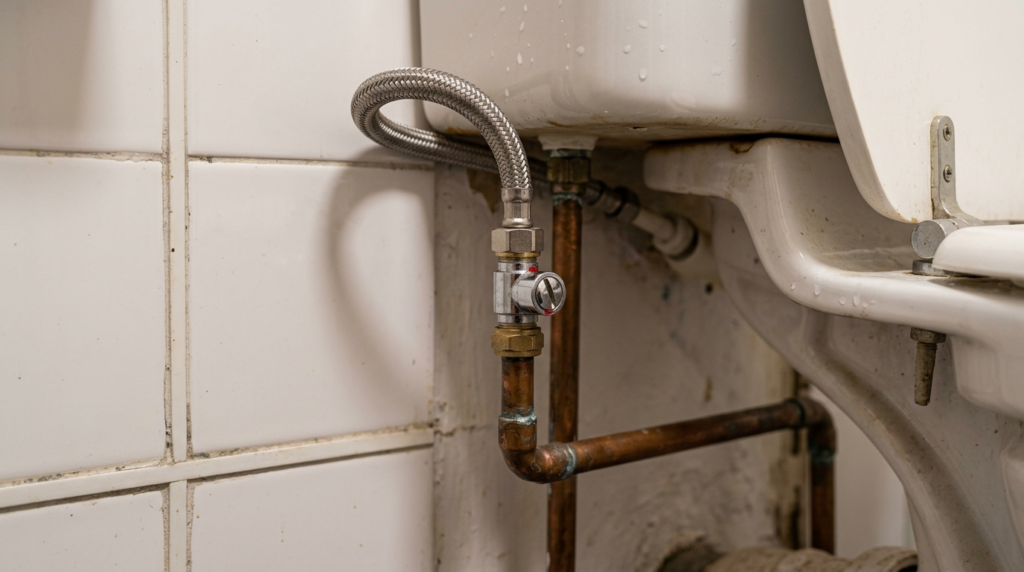
Most properties have isolation valves in these locations:
- Under the kitchen sink — usually one each for the hot and cold supply, plus one for the dishwasher if fitted
- Under bathroom and en-suite sinks — hot and cold, feeding the basin tap
- Behind or beside the toilet — controlling the supply to the cistern
- Behind the washing machine — typically a single valve on the cold feed, sometimes hot as well
- Near the boiler or water heater — isolating the appliance for servicing
- Just inside the wall where an outdoor tap’s pipe enters — controlling the garden or outside supply
- At the water meter or where the mains enters the property — the main stopcock, which isn’t a fitting-specific isolation valve but performs the same basic function for the whole house
If you can’t locate a valve for a specific fitting, or you find one that won’t turn, that’s a sign it may be due a service or replacement before it’s actually needed in an emergency.
How to Use a Plumbing Isolation Valve Safely
Operating an isolation valve is usually straightforward, but it’s worth doing properly.
Step 1 — Identify the right valve. Trace the supply pipe back from the fitting you’re working on to find its isolation valve. If there are two (hot and cold), make sure you close the correct one, or both if you’re unsure which feeds the fault.
Step 2 — Turn to close. For a lever valve, turn the handle 90 degrees until it sits across the pipe. For a slotted valve, use a flat-head screwdriver and turn clockwise until it stops — usually a quarter turn.
Step 3 — Confirm it’s closed. Open the tap or fitting briefly. If no water comes through (or it slows to a trickle and stops), the valve has done its job.
Step 4 — Carry out the repair or task. With the supply isolated, the relevant repair, replacement, or maintenance work can be carried out without affecting the rest of the property.
Step 5 — Reopen gently. Once the work is finished, turn the valve back to open and check for leaks at the valve itself and at the fitting before considering the job done.
If a valve won’t turn, feels gritty, or turns without actually stopping the flow, don’t force it — a seized or failed valve is a job for a qualified plumber rather than something to push through with extra force, which can snap the spindle and turn a simple isolation into a more involved repair.
Common Isolation Valve Problems
Isolation valves are simple devices, but they do develop faults, particularly when they sit unused for years between the day they’re fitted and the day someone actually needs them.
The valve won’t turn. This is the most common issue we’re called out for. Limescale builds up inside the valve body over time, especially in hard water regions, and the mechanism seizes in the open position. Because nobody touches these valves day to day, the seizure often isn’t discovered until an emergency, which is exactly the wrong moment to find out.
The valve leaks when closed. A worn O-ring or washer inside the valve can mean it doesn’t seal fully, allowing a slow drip to continue even when the lever or screwdriver slot shows it’s closed. This is often mistaken for a fault with the tap or appliance itself, when the valve is actually the source.
The valve leaks from the body or spindle. Over years of use, the seal around the spindle (the part that the lever or screwdriver connects to) can degrade, causing water to seep out around the valve housing whenever it’s operated. This is a classic sign that the valve itself has reached the end of its working life.
The valve turns but doesn’t fully shut off the supply. Internal wear on the ball or gate mechanism means the valve no longer creates a complete seal, even in the fully closed position. This is particularly dangerous because it gives a false sense of security — you believe the supply is isolated when it isn’t.
The valve has corroded or cracked. Brass and chrome valve bodies can corrode over time, particularly in older properties, and in rare cases a valve can crack outright, causing a leak at the fitting itself rather than at a seal.
If you recognise any of these signs, our leak detection and repair team can identify exactly where the problem lies and fix it properly, rather than leaving a faulty valve in place to fail again later.
Isolation Valve Installation and Replacement
New isolation valves are typically fitted in three situations: as part of a new installation (a new tap, toilet, or appliance), as a replacement for a valve that has failed, or to bring an older property up to current standards.
New installations. Current UK Water Regulations require isolation valves at specific points, so any new bathroom fitting, kitchen installation, or appliance connection should include the correct valves as standard. Our Bathroom Fitting and New Build Plumbing teams fit compliant isolation valves on every job as a matter of course.
Replacing a failed valve. When an old gate valve or a seized slotted valve needs replacing, we typically fit a modern quarter-turn lever valve in its place. These are more reliable long-term and far easier to operate in an emergency, which matters more than people often realise until they’re the one trying to stop a leak at 11pm.
Retrofitting valves where none exist. Some older properties, or DIY installations, are missing isolation valves altogether on certain fittings. We can retrofit the correct valve so that fitting can be isolated independently in future, without needing to use the main stopcock for routine work.
A typical isolation valve replacement is a quick job for a qualified engineer, usually completed within an hour, and it’s far cheaper to do proactively than to deal with a seized valve mid-emergency.
Isolation Valves and Frost Protection
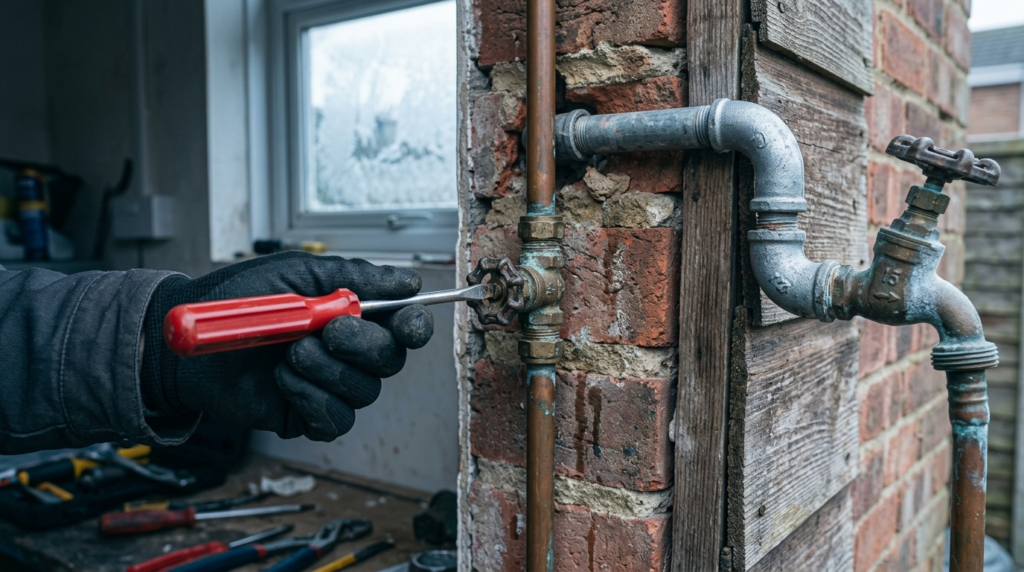
One of the most common call-outs we get every winter relates directly to isolation valves on outdoor pipework. If the isolation valve controlling a garden tap or outdoor supply isn’t closed (and ideally drained) before temperatures drop, water left standing in the exposed outdoor section of pipe can freeze, expand, and split the pipe or tap body.
This is entirely preventable. Before the first hard frost each year:
- Locate the isolation valve for your outdoor tap, usually just inside the wall where the pipe passes through
- Close the valve fully
- Open the outdoor tap briefly to drain any remaining water from the exposed section
- Leave the outdoor tap open over winter so any residual water has somewhere to expand
If your outdoor tap doesn’t currently have a dedicated isolation valve, that’s worth fixing before next winter rather than after a pipe has already split. Our team can fit one as part of a tap repair or replacement visit.
Isolation Valves and Water Pressure
A surprising number of water pressure complaints turn out to have a simple explanation: an isolation valve that isn’t fully open. This can happen after plumbing work where a valve wasn’t reopened completely, or where a valve has partially seized and only allows restricted flow even when it appears open.
If you’re experiencing reduced flow at a specific tap or appliance, but the rest of the property has normal pressure, checking the relevant isolation valve is one of the first things worth doing before assuming there’s a bigger problem with your pipework.
When to Call a Plumber
Plenty of isolation valve issues are simple enough to check yourself — locating a valve, confirming it’s open, or giving it a gentle test turn. But certain situations call for a professional rather than DIY effort:
- The valve won’t turn at all, or turns with excessive resistance
- The valve leaks when you try to close it
- You can’t tell whether the valve has fully isolated the supply
- The valve, pipework, or fitting around it shows signs of corrosion
- You need a valve fitted where none currently exists
- You’re dealing with an active leak and need the supply isolated immediately
If you’re in the middle of an active leak and can’t get the water to stop, don’t wait — call our 24/7 Emergency Line and we’ll talk you through it while help is on the way.
Why Choose Catalyst Home Services
Qualified engineers who know valves inside out. Every member of our team is trained to identify, repair, and replace every type of isolation valve found in UK properties. You can review our licences and certifications before booking.
Same-day availability across London. Whether it’s a seized valve stopping you from carrying out a repair, or a leaking valve that needs urgent attention, we offer same-day bookings across London boroughs.
Honest assessments, not unnecessary work. If a valve just needs a clean and a service, that’s what we’ll do. If it genuinely needs replacing, we’ll tell you why before any work begins. Read what our customers say on our reviews page.
Transparent pricing. You’ll always get a clear quote before work starts — no vague call-out charges, no surprises on the invoice.
Coverage across every London borough. Check our service areas to confirm we cover your postcode.
Related Services You May Need
Isolation valve issues often come up alongside other plumbing work. These are the services our customers commonly need at the same time:
- Tap & Faucet Repair — if a faulty valve is connected to a dripping or stuck tap
- Leak Detection & Repair — if you suspect a valve is leaking but can’t locate the source
- Water Pressure Issues — if a partially closed valve is restricting flow somewhere in the system
- Burst Pipe Repair — if a valve has failed during an active leak and pipework needs repairing too
- Bathroom Fitting — if you’re updating a bathroom and need compliant valves fitted throughout
- Emergency Plumbing — if you need someone out immediately to deal with an active leak
FAQs
Why Is My Isolation Valve Not Turning?
An isolation valve may stop turning because it has become seized due to limescale build-up, corrosion, or lack of use over many years. Since these valves often remain untouched until there is a plumbing problem, internal parts can become stiff and difficult to operate.
This is especially common with older slotted isolation valves that require a screwdriver to operate. Hard water areas, including many parts of London, can increase the chance of mineral deposits affecting the valve mechanism.
Avoid forcing a stuck isolation valve with excessive pressure, as this can damage the internal seal or cause the valve body to crack and leak. If the valve will not move with gentle pressure, it is usually safer to have it inspected by a qualified plumber. In many cases, replacing an old valve with a modern quarter-turn isolation valve provides a more reliable long-term solution.
Which Way Should an Isolation Valve Be Turned Off?
The method depends on the type of isolation valve installed.
For a quarter-turn lever isolation valve, turn the handle 90 degrees until it sits across the pipe. When the handle is aligned with the pipe, the valve is open and allowing water to flow. When it is positioned across the pipe, the valve is closed and the water supply is isolated.
For a slotted isolation valve, use a flat-head screwdriver and turn the slot approximately a quarter turn. When the slot follows the direction of the pipe, the valve is usually open. When the slot sits across the pipe, it is usually closed.
After closing an isolation valve, test the tap, toilet, or appliance it supplies to confirm the water has stopped before starting any repair work.
Where Is the Toilet Isolation Valve Located?
A toilet isolation valve is usually located on the small water supply pipe connected to the bottom or side of the toilet cistern. In most UK homes, you will find it close to the toilet, either directly behind the cistern, beside the toilet, or near the floor where the supply pipe enters the room.
The valve allows you to shut off water to the toilet without turning off the entire home’s water supply. This is particularly useful if the toilet is continuously filling, the inlet valve needs replacing, or there is a leak around the cistern connection.
If you cannot find the toilet isolation valve, check along the visible pipework from the toilet cistern back towards the wall. Older properties may not have one fitted, in which case the main stopcock may need to be used until a dedicated isolation valve is installed.
How Much Does It Cost to Replace an Isolation Valve in the UK?
The cost of replacing an isolation valve depends on the valve type, accessibility, and whether any additional pipework repairs are required. A straightforward replacement of an easily accessible valve under a sink, behind a toilet, or near an appliance is usually a quick plumbing job.
The overall cost can increase if the existing valve is seized, corroded, difficult to access, or connected to damaged pipework. Emergency call-outs may also affect the final price depending on the time and urgency of the repair.
Replacing an old or unreliable isolation valve with a modern quarter-turn valve is often a worthwhile improvement because it makes future repairs easier and reduces the risk of being unable to stop water during an emergency.
For an accurate cost, a plumber will normally need to inspect the valve, confirm the issue, and provide a quote based on the work required.
Book an Isolation Valve Repair or Installation Today
Whether you’ve discovered a seized valve mid-repair, found a slow leak you can’t trace, or simply want your home’s valves checked and serviced before winter, Catalyst Home Services is ready to help. Call us now on +44 7400 265421, use our 24/7 Emergency Line if you’re dealing with an active leak, or book a plumber online and we’ll confirm your appointment straight away.